Reading with AI 04 | The Intelligent Investor: Chapter 4 — Portfolio Policy for the Defensive Investor
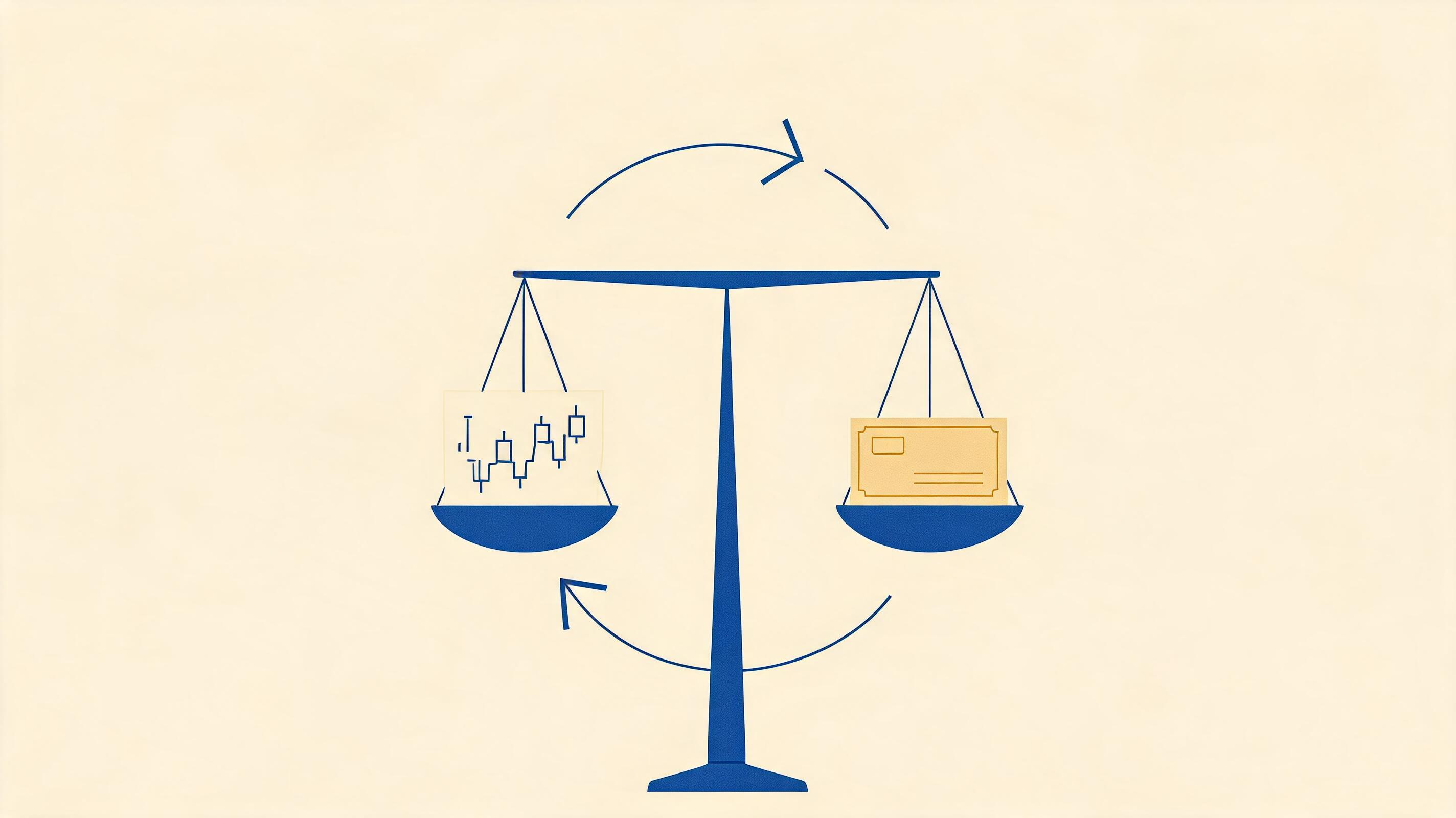
Episode 004 of "Reading with AI." The Intelligent Investor (1973 4th edition + Jason Zweig's commentary), Chapter 4, "Portfolio Policy for the Defensive Investor." The previous chapter used a century of stock market history to build a yardstick for "is it expensive now"—concluding that in early 1972, "from a conservative investment standpoint, valuations lacked attractiveness." So how should you actually act? This chapter gives Graham's most famous recipe: stocks 25%–75%, bonds 75%–25%, standard allocation 50/50. It sounds almost too plain, but as you read deeper you'll find he spends the whole chapter dismantling "why bonds are mandatory," "why split down the middle," "why never go to extremes," plus a complete bond toolkit; and in his commentary Zweig all but overturns today's popular practices—"set your stock percentage by your age," "go all-in on index funds," "build a base with preferred stocks"—and caps it with the line: "Replacing guesswork with constraints—this is the essence of Graham's investing method."
All the wisdom of defensive investing may be distilled into one action: every six months, sell a little of what has risen, buy a little of what has fallen, then do nothing
The Core Question of This Chapter
For an ordinary person who has no ambition to become an expert and just wants peace of mind and safety—what should their portfolio look like? How much in stocks and how much in bonds? When should they adjust it? And how should they pick the bond half?
Graham opens by demolishing a principle that sounds impeccable—"if you cannot take risk, you should be content with a lower investment return." He states flatly, "We cannot accept this proposition." In its place he sets a standard that runs through the whole book:
The rate of return sought by investors should be determined more by what they are willing and able to put into their investment in the way of intelligence: the easy-going and safety-minded defensive investor deserves the lowest return; the astute and experienced investor, who puts the maximum of intelligence and skill into his investments, deserves the maximum return.
In other words: what determines your return is not whether you "dare to take risk," but whether you are willing to invest wit and effort. The defensive investor is not willing to, so he can only earn the "lowest return"—but Graham's mission is to make sure he at least collects that minimum reliably. This chapter is written for exactly that person.
He also adds, as supporting evidence, an old judgment from 1965: "In many cases, buying 'bargain securities' actually involves less risk, and offers a greater chance of profit, than buying conventional bonds yielding 4.5%." The sharp rise in interest rates over the following years—which shrank even the highest-grade long-term bonds—proved the point in reverse. "Risk and return are proportional" was never Graham's line.
Graham's Text
Key Point 1: The Defensive Investor's Core Recipe—One Sentence
Compress the whole chapter's strategy into one sentence:
Divide the funds between high-grade bonds and high-grade common stocks.
The specific ratio rule is only one line:
As a basic guiding principle, we suggest that such an investor never hold less than 25% or more than 75% of his funds in common stocks; correspondingly, his bond holdings should range between 75% and 25%.
Read those two lines side by side and the defensive investor's entire prescription is four numbers:
| Asset | Minimum | Maximum | Standard |
|---|---|---|---|
| Stocks | 25% | 75% | 50% |
| Bonds | 75% | 25% | 50% |
The standard division between the two major investment media should be half and half. By tradition:
- A continued bear market producing "bargain price levels" → increase the stock proportion (up to 75%);
- Market prices rising to dangerous heights → reduce the stock proportion below 50% (down to 25%).
That is all. After reading every asset-allocation book economists have written since, you'll find Graham's few lines are still the cleanest version around.
Key Point 2: Why Is 50/50 Hard to Do?—It Collides Head-On with Human Nature
Having written the rule, Graham immediately confesses its weakness:
It is difficult to adhere to this consistent policy because it is so, let us say, unnatural to reduce one's stock holdings when the market is unduly high, and to increase them when the market is unduly low. It does not appear to be a workable approach for the general run of investors.
The next sentence matters even more:
It was precisely the opposite policy followed by the general investor (who, it appears, is compelled to do so) that produced the great advances and declines of the past, and similar (if not quite so extreme) swings are likely to occur again.
This is not a description of market behavior; it is an attribution of it: the big swings themselves are stacked up by the crowd doing the opposite. Which means—50/50 works precisely because it is something most people cannot do.
What about professional investors? They can't do it either. After 1949, "professional investors of the mutual-fund type have rarely operated this way"—balanced and equity funds changed their stock positions very little, and their selling was mainly to switch holdings. The entire industry ceded "rebalancing" to "stock picking," and it still does today.
Key Point 3: Bonds Are the Reference Point—Irreplaceable
Why does Graham insist on dragging bonds into the portfolio, and never letting them fall below 25%? Because without bonds, the whole rule loses its anchor:
We have long held the view that, without the benchmark of bond yields, we could not set a dependable rule for determining when the stock proportion should be reduced to a minimum of 25% and later raised to a maximum of 75%.
Plug in the scene of early 1972: Graham found it "hard to see" any reason for investors to feel confident that stock holdings were "sufficiently justified" and that they could "face with equanimity" a decline like that of 1969–1970. So he did not recommend holding more than 50% in stocks; on the other hand, "we would find it difficult to advise the investor to reduce his stock proportion below 50% unless he is deeply worried by the prevailing price level and satisfied to hold only (say) 25% of his funds to participate in any future rise."
Both extremes are "difficult," so the 50/50 midpoint becomes the only default that can be prescribed universally. That is the real origin of the half-and-half split—it was not proven optimal; it was proven hardest to get wrong.
Key Point 4: The Mechanics of Rebalancing—"Sell One-Eleventh"
Graham's operating rule is purely mechanical:
Under this rule the investor would keep his bond and stock holdings equal in actual practice. Say, for example, that stock prices rise so that the stock proportion reaches 55% of the portfolio; he should be prepared to sell one-eleventh of his shares and put the proceeds into bonds, restoring the balance. Conversely, if his stock holdings fall to 45% of the total, he should consider taking one-eleventh of his bonds and converting them into stocks.
Note the arithmetic here: when stocks rise from 50% to 55%, you don't sell 5%; you sell 1/11 of the stock position—only that pulls 55/45 back to 50/50. This deliberate mechanical trigger turns the decision most easily hijacked by emotion—"should I sell?"—into a cool math problem.
Key Point 5: The Yale Example—Why a Popular Standard Gets Abandoned
Graham deliberately cites Yale University as a counterexample. After 1937 Yale long followed a similar rule, with a "normal holding" of about 35% in stocks. But "since the early 1950s, Yale appears to have abandoned this once-famous formula; by 1969, its stock proportion was as high as 61% (including some convertible bonds)." Meanwhile, across 76 comparable institutions with $7.6 billion invested, stocks accounted for 60.3%.
Yale's abandonment is not a refutation but a confirmation—even the institutions most supposed to hold discipline couldn't stand a conservative 35% ratio in a bull market. But Graham does not retract:
We continue to think that the 50/50 division of funds has real significance for the defensive investor. It is very simple; its direction of operation is unquestionably right; it makes its followers feel that they are at least making some response to market changes; and, most important of all, it prevents the investor from continually increasing his stock investment as the market climbs to increasingly dangerous heights.
Of the four reasons, only the fourth is economic; the first three are behavioral: simple, directionally right, and gives the follower the feeling of responding. When Graham designs a portfolio, he is never just doing arithmetic—he is also computing "whether a human being can actually carry it out."
And the psychological payoff runs both ways:
The truly conservative investor will be satisfied with the gains on half his money in a bull market; and in a deep bear market, comparing his lot with that of the aggressive investor, he will derive comfort from his relatively better position.
Contentment in bull markets, consolation in bear markets—what 50/50 really supplies is a steady current of emotional stability.
Key Point 6: 50/50 Is Not Necessarily Optimal—The 1972 Arithmetic
Graham does not pretend the split is best:
While this 50/50 division of funds is undoubtedly the simplest of all "all-purpose" devices, it will not necessarily produce the best results.
There was a specific fact in early 1972: high-grade bonds yielded considerably more than large blue-chip stocks—which made a powerful case for raising the bond proportion. If you could act "like an unemotional, mathematically minded gambler," you could cut stocks to 25% and keep them there until the dividend return on the Dow-Jones industrials rose to two-thirds of the bond interest rate, then raise your stock proportion to 50%.
He offered a computable "buy point": with the Dow at 900, unit dividends of $36, and pre-tax bond yields of 7%, to satisfy "dividend yield = 2/3 of bond interest," either:
- bond yields fall from 7% to 5.5%, with blue-chip yields unchanged; or
- bond yields stay at 7%, and the Dow falls to 660 (a drop of 27%).
That is the objective trigger for moving stock holdings from 25% back to 50%—not a gut feeling, but a calculation. And he doesn't dodge the hard part: "to accept it and stick to it, regardless of whether the results may prove the strategy too conservative."
Key Point 7: The Bond Toolbox—Taxable or Tax-Exempt, Short or Long Term
Now to "what exactly to buy for the bond half." Graham cuts it with two questions:
Question 1: Taxable bonds vs. tax-exempt bonds (municipals)—a math problem
In January 1972, 20-year Aa corporate bonds yielded 7.5%, good tax-exempt bonds 5.3%—corporates yielded about 30% more than municipals.
| Investor's tax bracket | Better choice |
|---|---|
| ≥ 30% | Municipal bonds (tax-exempt) |
| < 30% | Corporate bonds (taxable but higher yield) |
The 30% bracket applied to single income above $10,000 of deductions and joint married income above $20,000—so for most investors, municipals were the better buy.
Question 2: Short-term vs. long-term—do you want to lock in the price?
- Want to make sure the bond's market price won't fall? The cost is (1) a lower annual yield; (2) giving up appreciation of principal.
- He defers this question to Chapter 8 (market fluctuations).
Key Point 8: Four Bond Types Worth Knowing
Graham lists four categories available in the U.S. market in 1972, from safest on down:
| Type | Key characteristics | Yield (early 1972) |
|---|---|---|
| U.S. savings bonds (Series H/E) | Absolute guarantee of principal and interest; redeemable at cost at any time; at least 5% interest for 10 years; tax-deferral advantages can lift after-tax return by 1/3 | Series H: 4.29% in year 1, 5.1% for the other 9 years; Series E: 5.7% to maturity (5 years 10 months) |
| Other federal government bonds | Principal and interest payments very safe; interest exempt from state income tax | Long-term 6.09%, intermediate 6.35%, short-term 6.03% (end of 1971) |
| State and municipal bonds | Exempt from federal income tax, usually from state tax too; buy only Moody's/S&P rated AAA/AA/A | S&P Municipal Bond Index (AA-rated, 20-year) average 5.78% |
| Corporate bonds | Subject to federal and state income tax | Aaa 25-year 7.19%; Baa long-term 8.23% |
Graham's special fondness for savings bonds deserves highlighting: "No other investment combines the following: (1) an absolute guarantee of payment of principal and interest; (2) the right to withdraw all principal and interest at any time; (3) interest of at least 5% for a period of at least ten years." He even said "the unique advantages of holding savings bonds are sufficient to offset the drawback of their lower current yield"—one of the highest compliments he pays any single asset in the entire book.
Key Point 9: High-Yield Bonds—"It Is Advisable for the Ordinary Investor to Avoid This Type"
Graham's attitude toward junk bonds is brusque:
So far as the ordinary investor is concerned, it is advisable to avoid this type of high-yield bond. Although their overall return has been higher than on high-grade bonds, they expose their owners to a variety of unfavorable risks—both annoying declines in price and actual default.
Zweig adds an important correction in a footnote: today, through diversification and research in mutual funds, the risks Graham criticized in high-yield bonds have been reduced—but the boundary of Graham's original text still stands as the default: unless you have specialized research and skill, don't touch individual high-yield bonds.
Key Point 10: Call Provisions—"Heads I Win, Tails You Lose"
The most biting passage of the chapter. Graham's post-mortem on a 100-year American Gas & Electric bond should be memorized by anyone who has ever bought a callable bond:
The maturity was 100 years, the coupon rate 5%. The bond was issued to the public at 101 in 1928. Four years later, in the atmosphere of panic, this sound bond sold at 62.5, yielding 8%. By 1946, after a strong recovery, bonds of this class were selling to yield only 3%, so the price of the 5% issue should have been close to 160. But at that point the company exercised its call provision and redeemed the bonds at just 106.
Line up those numbers: theoretically the bond could have reached 160; in reality it was called away at 106—the investor bore the entire downside (down to 62.5) yet was stripped of most of the upside (160 → 106). Graham sums up this kind of contract in one line:
The call provision in such a bond contract amounts to an open declaration: "Heads I win, tails you lose."
His practical advice:
- Accept a somewhat lower coupon to make sure the call protection runs at least 20–25 years from issuance.
- Buying low-coupon bonds at a discount > high-coupon bonds callable in the near term.
- Example: a 3.5% coupon bond selling at 63.5% of par yields 7.85%—the discount is enough to protect against the adverse effects of a call.
Key Point 11: Nonconvertible Preferred Stock—"Unsound in Essence"
Graham's verdict on preferred stock uses some of the harshest language in the book:
Really good preferred stocks may and do exist, but they are good in spite of their character as preferred stocks—sound in form, but unsound in essence.
The reason is that it falls short on both kinds of rights:
| Legal claim | Share in profits | |
|---|---|---|
| Bondholder | ✅ Yes (statutory creditor's claim) | ❌ No |
| Common shareholder | ❌ No | ✅ Yes (partner status) |
| Preferred shareholder | ❌ No (the company has no obligation to pay preferred dividends when it isn't paying common dividends) | ❌ No (receives only a fixed-rate dividend) |
Moreover, the tax position of preferred stock suits corporate investors: in 1972 the corporate tax rate was 48%, but corporate dividends were taxed at 15% ($100 of dividends cost only $7.20 in tax), while $100 of bond interest cost $48. So "corporate investors should buy preferred stocks, while individual investors subject to income tax should buy tax-exempt bonds."
Key Point 12: Income Bonds—A Good Tool Buried by Prejudice
At the chapter's end Graham takes up the cause of a nearly forgotten instrument. The income bond: interest is paid only when the issuing company earns it (interest can accrue, typically payable out of future earnings within three years).
Its advantages are twofold:
- Company earns a profit → the investor receives interest unconditionally;
- Company earns no profit → the investor retains protections beyond bankruptcy shelter.
And the interest is deductible against taxable income, halving the cost of capital—yet Wall Street preferred the less safe preferred stock and rejected the safer income bond. Graham writes this choice up as an indictment of the whole industry:
The willingness of people to buy the less safe preferred stocks while rejecting the safer income bonds shows how much Wall Street clings to traditional practices and customs, ignoring the need for new ideas under new conditions. With every ebb and flow of optimism and pessimism, we forget history and cast aside time-tested principles, yet stubbornly hold on to our prejudices and believe in them firmly.
This passage could almost serve as the epigraph of the whole book—it is not about any particular security, but about the core of Graham's methodology: always ask, "Is this conclusion based on mechanism, or on convention?"
Zweig's Commentary (4th Edition)
Opens by quoting basketball coach Pat Riley: "If you just try to luck it out, suddenly all your good luck goes away."
Commentary 1: Risk Depends First on Who You Are, Not What You Buy
Zweig boils Chapter 4's core down to one sentence:
Graham's insight is that it depends first on what kind of investor you are, not on what investments you own.
The two approaches of the intelligent investor:
| Approach | Alias | Demands |
|---|---|---|
| Active | Enterprising | Continuous research, selection, and monitoring of a dynamic portfolio—great time and effort |
| Defensive | Passive | Create a permanent portfolio and put in no further effort (though it may look boring)—always unmoved by the market's noise |
Zweig enlists investment thinker Charles Ellis as corroboration: "The active way is mentally taxing, while the defensive way demands mastery of your emotions."
Both approaches are equally sensible and can both succeed, provided you:
- Know yourself deeply and adopt the approach that fits you;
- Stick with it throughout your investing life;
- Are good at controlling both your investing costs and your emotions.
The oft-quoted summary appears here:
Graham's distinction between active and passive investing reminds us again that financial risk lies not only where most people look for it (in the economy and in investments) but also within ourselves.
Commentary 2: Graham Never Mentions "Age"—He Refuses to Set Stock Percentages by Age
Zweig catches a striking omission:
Most striking is that nowhere in Graham's discussion of allocating between stocks and bonds does the word "age" appear. This sets him apart from the vulgar conventional wisdom of the day.
The popular formula is "stock percentage = 100 − your age"—72% stocks at 28, 19% at 81. Popular books of 1999 (Glassman and Hassett's Dow 36,000) even claimed: anyone under 30 could put 90% of their money into stocks, even with a very "thin" tolerance for risk.
Zweig's retort is sharp to the point of acid:
Why should your age determine how much risk you can afford to take?
Commentary 3: Two Counterexamples—The Widow with $3 Million vs. the 25-Year-Old
Zweig uses two counterexamples to dismantle "age determinism":
| Case | By the age formula | Zweig's judgment |
|---|---|---|
| A widow with $3 million, a generous pension, and a crowd of grandchildren | Should hold mostly bonds | "It would be utter foolishness for her to put most of her assets in bonds." She already has ample income, and her grandchildren have decades of investing life ahead of them |
| A 25-year-old saving to marry and buy a home | Should be 70%+ in stocks | "Would never dream of putting all his money in stocks." If the market takes a high dive, he has neither bond income to cushion the loss nor cash for emergencies |
And besides—at any age, you may suddenly need a large sum of money: job loss, divorce, disability, who-knows-what emergency. "Everyone should keep part of their assets in cash, in a risk-free, safe place."
Age is not risk tolerance; life situation is.
Commentary 4: What the 25% in Bonds Is Really For—A Psychological Cushion, Not Yield Optimization
Psychologists have found: most people are bad at predicting how they will feel when distressing things actually happen to them.
| Point in time | The investor's imagination / reality |
|---|---|
| Stocks rising 15%–20% a year (the '80s and '90s) | Imagines "I'll stay with stocks for life" |
| Watching $1 shrink to a dime | Can't resist the lure of "safe" bonds or cash |
Many people ended up not buying and holding, but buying high and selling low, with painful results.
That is why Graham insisted that every investor hold at least 25% in bonds:
In his view, this cushion of bond investments would give you the courage to keep holding the rest of your stocks through bad markets.
The first function of bonds is not to "earn more" but to "keep you from fleeing." It's the same grammar as Graham's own "most important of all, it prevents the investor from continually increasing his stock investment as the market climbs to increasingly dangerous heights"—a tool of discipline, not of return.
Commentary 5: A Checklist for Examining Your Own Life—Choosing 25% or 75% in Bonds
Zweig translates "how to choose between the ends of the 25%–75% range" into a concrete life questionnaire:
- Are you single or married? What does your spouse or partner do for a living?
- Do you have or expect to have children? When will their tuition become a necessary family expense?
- Will you inherit money? Or do you need to support elderly or ailing parents?
- What factors could hurt your job prospects?
- Working for a bank or a builder → a sudden jump in interest rates could cost you your job;
- Working for a chemical company → soaring oil prices are bad news.
- If you run your own business, how long can businesses like yours typically survive?
- Do you need your investment income to help cover living expenses? (Generally speaking, bonds can help you out; stocks cannot.)
- Given your salary and expenses, how large an investment loss could you absorb?
Read the whole list, then pick a side:
- Can take more stock risk → hold bonds and cash at Graham's minimum ratio of 25%;
- Cannot → hold bonds and cash at Graham's maximum ratio of 75%.
This isn't really a questionnaire—it's the thinking method of "facts before conclusions": first look at the real cash flows and real risks in your life, then fill in that 25%–75% slot.
Commentary 6: Replace Guesswork with Constraints—Rebalance Every Six Months
Once the allocation is set, what then?
Once you have determined a final asset allocation, don't fiddle with it lightly unless your life circumstances change dramatically. Don't increase the proportion of stocks because the market has gone up, and don't sell more because it has gone down.
Replacing guesswork with constraints is the essence of Graham's investing method.
Zweig offers a concrete template: suppose the target is 70% stocks + 30% bonds; stocks rise 25% (bond prices unchanged), and the stock share is now near 75%—log on to your 401(k) account website, sell some stocks, and get back to 70/30.
Frequency: "Rebalance your assets on a predictable, regular basis: not so often that you drive yourself crazy, and not so rarely that your target allocation stays out of line for long stretches. I'd say exactly once every six months—pick an easy date to remember, like New Year's Day or July 4."
The beauty of this periodic rebalancing is that it forces you to base your decisions on a simple, objective standard—has this asset grown beyond its allotted share of my plan?—rather than on guesses about the direction of interest rates or the Dow.
Commentary 7: Why Not Put Everything in Stocks—The 6-Point Test
Graham caps stocks at 75%, so the other 25% is always bonds/cash—could you ever go 100% stocks? Zweig says yes, for a tiny minority, but you must pass all of these six tests:
- Have set aside for your family a full year's worth of living expenses;
- Are prepared to keep investing for the next 20 years;
- Successfully rode out the bear market that began in 2000;
- Did not sell stocks during the bear market that began in 2000;
- Bought more stocks during the bear market that began in 2000;
- Have read Chapter 8 of this book and begun to carry out a formal plan to restrain your investing behavior.
Unless you genuinely pass all of these tests, you must never put all your money into stocks. The people who panicked in the last bear market will panic again in the next one, and they will sorely regret having no bonds or cash as a cushion.
Tests 3, 4, and 5 are retrospective—they demand a behavioral record paid for in real money, not a present-tense "I believe I would."
Commentary 8: Three Modern Choices for Bond Investing
Zweig updates Graham's bond toolbox to 2003:
1. Tax-exempt vs. taxable
- Unless you are in the lowest tax bracket, put all money outside retirement accounts into tax-exempt bonds;
- The only appropriate place to buy taxable bonds is a 401(k) or other tax-sheltered account (municipals waste their tax advantage inside those accounts).
2. Short-term vs. long-term
Bonds and interest rates sit on a seesaw: rates up → bond prices down (short-term bonds fall far less than long-term); rates down → bond prices up (long-term bonds rise more).
For most investors, intermediate-term bonds are the simplest choice, because they free you from fretting over the future direction of interest rates.
3. Individual bonds vs. bond funds
- Individual bonds are typically sold in $10,000 units;
- You'd need to buy at least 10 different issues to diversify away default risk;
- So unless you have at least $100,000 to invest, buying individual bonds directly makes no sense (long-term U.S. Treasuries are the sole exception);
- Bond funds provide the benefits of diversification cheaply and conveniently, and their monthly interest can be reinvested at prevailing rates with no sales charge—for the general investor, bond funds are the obvious choice.
Commentary 9: Cash Has Its Place Too—Squeezing Yield from Cash
Zweig lists cash instruments that can replace traditional savings:
| Instrument | Key features | Caveats |
|---|---|---|
| Treasury bills (T-bills) | 4-week/13-week/26-week; no default risk; interest exempt from state income tax; can be bought commission-free directly from the government | Tiny losses when rates spike, versus brutal drops in long-term Treasuries |
| Savings bonds (including I bonds) | Non-marketable; early redemption costs 3 months of interest; minimum denomination $25; inflation-protected I bonds yield 4% | Good for an "emergency fund" or gifts to children |
| Mortgage securities (Fannie Mae/Ginnie Mae) | No Treasury guarantee, higher yields | Fall harder when rates are low, rise more when rates are high; refuse to buy individual mortgages or CMOs |
| Annuities | Insurance-like; tax-deferred; provide an income stream in retirement | Beware annuities sold at high cost—big commissions = poor returns; buy only low-cost, direct, from the likes of Ameritas, TIAA-CREF, Vanguard |
Commentary 10: Preferred Stock—"Like Meeting an Unrefrigerated Dead Fish at the Market"
Zweig translates Graham's verdict on preferred stock into a modern version and adds a layer of reasoning:
Preferred stocks combine two drawbacks. First, they are less safe than bonds, because if the company goes bankrupt, preferred shareholders stand behind creditors in the claims line. Second, they have less profit potential than common stocks, because if interest rates fall or the company's credit improves, the issuer typically "calls" or forcibly buys back the preferred shares.
Even sharper is this rhetorical question:
Ask yourself: If the company is healthy enough to be worth your investment, why would it issue preferred stock and pay fat dividends on it, rather than issue bonds and enjoy their tax deduction? The likely answer is that the company's finances aren't healthy enough, and the market has no appetite for its bonds.
So approach a preferred stock the way you would approach an unrefrigerated dead fish at the market.
Commentary 11: Stocks Deserve a Place Too
At the end of his commentary Zweig fills in the other side—going all-bonds is also wrong. In early 2003, 115 stocks in the S&P 500 had dividend yields of 3% or better.
But he lays down a principle first:
No intelligent investor, however hungry for dividends, should ever buy a stock solely for its dividend; the underlying company and its business must be solid and strong, and the price must be reasonable.
After the bear market that began in 2000, "some leading stocks now yield more than long-term Treasuries":
Even the most conservative investor should realize that selectively adding some stocks to an all-bond or bond-heavy portfolio will increase its yield and improve the portfolio's overall potential return.
This is Chapter 4's full field of view: bonds never leave the stage, stocks never leave the stage—each serves as the other's reference point, the other's psychological cushion, the other's contrary position—and that is the real asset philosophy behind 50/50.
Untangling the Hard Parts
Hard part 1: 50/50 sounds too plain—why does Graham make it the "standard allocation"?
Because "standard" here means not proven optimal but proven hardest to get wrong. Graham's own chain of logic runs:
- At early-1972 price levels he found it "hard to see" grounds for investors to hold more than 50% in stocks with confidence;
- It was equally "difficult to advise" investors to go below 50% in stocks;
- Both extremes are "difficult," so the midpoint 50/50 becomes the only default that can be prescribed universally.
And he adds four non-economic reasons: simple; directionally right; makes the follower feel they are responding; and it keeps investors from continually increasing their stock investment as the market climbs to dangerous heights. The first three are behavioral; the fourth is the safety net—50/50's real value lies in "at minimum, it stops you from doing something worse."
Hard part 2: How do I actually choose between the ends of the 25%–75% range?
Zweig's checklist is the answer: not by looking first at your age, not at a risk-tolerance questionnaire, but at your life's real cash flows and real risks.
- Is your job tied to interest rates, oil prices, or the stock market itself?
- Do you need investment income to help cover living expenses? (Bonds can; stocks can't)
- Are there big expenses coming soon (wedding, home purchase, children's tuition, supporting parents)?
- How large an investment loss can you absorb—not imagined, but computed from your salary and expenses?
"Risk tolerance" is a number you calculate, not a number you feel. Compute it first, then pick your slot: 25%, 50%, or 75% in bonds.
Hard part 3: Why is "replacing guesswork with constraints" the essence of Graham's method?
Graham says repeatedly in the original text: "It is difficult to adhere to this consistent policy because it is unnatural to reduce one's stock holdings when the market is unduly high, and to increase them when the market is unduly low." The general investor's contrary behavior is precisely what caused the great swings of the past.
Zweig translates this into an executable version: set the proportions in advance → mechanically rebalance every six months → neither add to stocks because the market rose, nor sell more because it fell. The difficulty is not the formula (sell 1/11); it is "not caring whether the results may prove the strategy too conservative"—the real opponent of rebalancing is not the market but your own "this time is different."
Hard part 4: The bond toolbox—how should an individual investor actually choose?
Simplified decision tree:
1. Inside a retirement account (401(k)/IRA)?
   ├─ Yes → buy a taxable high-grade bond fund (enjoy tax deferral)
   └─ No → go to 2

2. Tax bracket ≥ 30%?
   ├─ Yes → buy a municipal (tax-exempt) bond fund
   └─ No → buy a taxable high-grade bond fund

3. Individual bonds vs. bond fund?
   ├─ Funds < $100,000 → bond fund (except for long-term U.S. Treasuries)
   └─ Funds ≥ $100,000 → can diversify across individual bonds

4. Maturity?
   └─ Intermediate (5–10 years)—"no more fretting over interest-rate guesses"

5. Always avoid:
   ├─ high-coupon bonds callable in the near term ("heads I win, tails you lose")
   ├─ nonconvertible preferred stock ("unrefrigerated dead fish")
   └─ high-cost annuities sold by salesmen (big commissions = poor returns)
Graham's special fondness for savings bonds (absolute guarantee + redeemable at any time + at least 5% interest for 10 years + tax-deferral advantages) finds its closest counterparts in the Chinese context in treasury bonds, policy bank bonds, and large bank certificates of deposit—not P2P, not "fixed-income plus" funds, not structured deposits.
One-Sentence Takeaway
The defensive investor's entire prescription fits on one line: stocks 25%–75%, bonds 75%–25%, standard allocation 50/50, rebalance every six months. This rule works not because it is optimal, but because it is simple, directionally right, makes you feel you are responding, and—most critically—stops you from continually increasing your stock investment as the market climbs to dangerous heights. The first function of bonds is not to "earn more" but to "keep you from fleeing." Replacing guesswork with constraints is the essence of Graham's investing method—and your asset allocation should be determined by your life's real cash flows and real risks, not by your age.
Questions to Leave You With
- Work out your current stock/bond ratio. Was it set to some target, or did it "just evolve" because you never sold after gains and never bought after losses? If you forcibly pulled the ratio back to 50/50 today (or any target you've set), how much stock would you have to sell and how many bonds buy? Could you actually bring yourself to do it?
- Fill out Zweig's checklist: what your spouse does for a living, children's tuition, whether you support parents, whether your job is tied to interest rates/oil prices/the stock market, whether you need investment income to cover living expenses, how large a loss you could absorb. Once you've filled it in—which of the three slots—25%, 50%, or 75% in bonds—belongs to you? Does your actual allocation match your answer?
- Graham requires all investors to hold at least 25% in bonds as a "psychological cushion." Zweig goes further: "The people who panicked in the last bear market will panic again in the next one." Recall your actual behavior in the most recent bear market—did you sell, sit out, or buy more? If the answer is sell or sit out, shouldn't your actual bond allocation be higher than what you "imagine" you can tolerate?
- Graham once wrote a concrete "buy point" formula: raise the stock position from 25% to 50% only when the dividends on the Dow components reach two-thirds of the bond interest rate. Translate this formula into an index you know today (say, the CSI 300's or S&P 500's dividend yield vs. the 10-year treasury yield): what is the current ratio? To trigger the "double the stock position" buy point, how far must the index fall, or how much must the treasury yield drop?
- Graham summed up call provisions as "heads I win, tails you lose" and dismissed preferred stock as "unsound in essence." Do you hold any assets in your current portfolio that are "locked by contract, capped on the upside, bearing the full downside"—for example, certain structured deposits, redeemable bond funds, or wealth-management products with a "performance benchmark" but losses you bear yourself?
Next episode: Chapter 5, "The Defensive Investor and Common Stocks"—with the bond half covered, what should the stock half hold? Graham gives the defensive investor four fixed rules for selecting common stocks (adequate but not excessive diversification; each company should be large, prominent, and conservatively financed; a long record of continuous dividend payments; limits on the P/E ratio), and explains why these seemingly bland constraints are precisely what keeps "being locked in for a decade after buying a great company too expensive" outside the door.
Comments · 0